



Manufacturing plants, production facilities, and massive industrial complexes are the beating heart of the modern economy. But what keeps that heart pumping? It is the intricate, robust, and often high-voltage electrical systems that power everything from conveyor belts to robotic assembly arms. At the center of this vital infrastructure is the industrial electrician. Choose the best EV charger installation Littleton CO.
If you are considering a career in this field, or if you are looking to upskill your current electrical repertoire, you are stepping into a world that demands precision, technical mastery, and an unwavering commitment to safety. Unlike standard residential work, an industrial electrician operates in high-stakes environments where a single system failure can cost a company thousands of dollars per minute in lost production.
This comprehensive guide will break down the essential skills every industrial electrician needs to succeed. We will cover the technical know-how, safety protocols, troubleshooting methodologies, and career advancement steps that separate the novices from the true experts in the field.
The Core Foundation: Understanding the Role
Before diving into the specific technical skills, it is crucial to understand what sets this profession apart from other electrical trades. The environment, the equipment, and the scale of the power systems are fundamentally different.
The Difference Between Commercial and Industrial Wiring
A common point of confusion for those entering the trade is understanding the difference between commercial and industrial wiring. While a commercial electrician might wire an office building, a retail store, or a restaurant, their primary focus is usually on lighting, standard power receptacles, and commercial-grade HVAC systems. The voltages typically range from 120V to 480V, and the wiring is often concealed within drywall or drop ceilings.
An industrial electrician, on the other hand, deals with entirely different beasts.
- Voltage and Power: Industrial facilities often utilize massive amounts of power. You will frequently work with three-phase power systems operating at 480V, 600V, or even medium-to-high voltage distribution systems (up to 4,160V or higher).
- Wiring Methods: Industrial wiring is rarely hidden. It is typically run through rigid metal conduit (RMC), cable trays, or armored cable (Teck cable) to protect it from harsh environments involving corrosive chemicals, extreme heat, or physical impact.
- Equipment: The loads are primarily inductive (heavy motors, transformers, and industrial machinery) rather than resistive (lighting and heating).
- Scale: The systems are vast and interconnected. A fault in one area can cascade through a facility if not properly isolated.
Understanding this difference is the first step in realizing that industrial electrical work requires a highly specialized skill set.
The Pathway: Electrical Apprenticeship Program Duration
Mastering these systems does not happen overnight. The journey begins with a rigorous educational and practical foundation. The typical electrical apprenticeship program duration ranges from four to five years, depending on your region and the specific program requirements.
During this time, apprentices divide their time between:
- Classroom Instruction: Learning electrical theory, mathematics, blueprint reading, and building codes.
- On-the-Job Training (OJT): Working under the direct supervision of a licensed journeyman or master electrician, accumulating between 8,000 and 10,000 hours of practical experience.
In the industrial sector, this apprenticeship is where you learn to respect the power you are working with. It is a period of intense learning where you absorb the practical nuances of heavy machinery, motor controls, and rigid conduit bending.
Technical Proficiency: The Hard Skills You Need
The toolbox of an industrial electrician is filled with far more than just wire strippers and multimeters. The modern manufacturing environment is a hybrid of heavy electrical power and delicate electronic automation. To thrive, you must master the intersection of these two worlds.
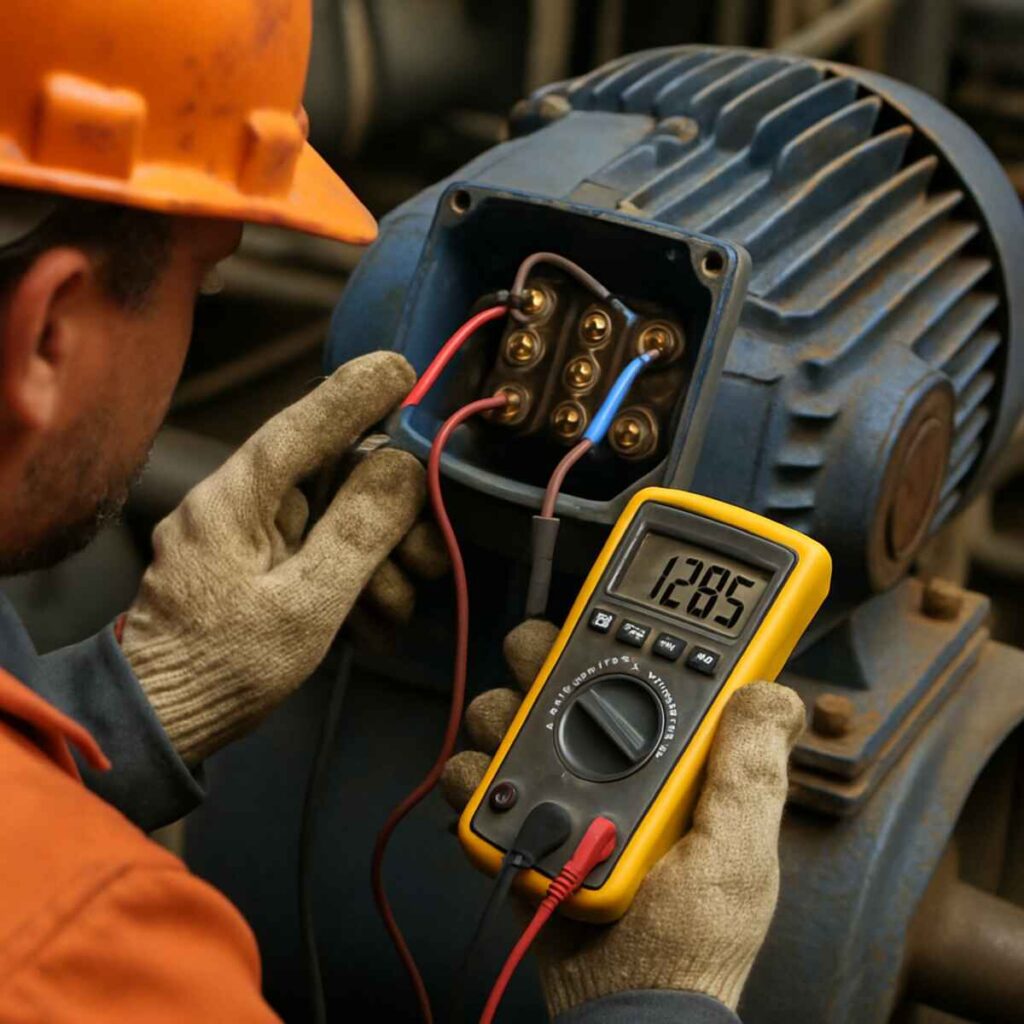
Mastery of Three-Phase Motor Control Systems
If there is one universal truth in industrial manufacturing, it is this: motors run the world. Conveyors, pumps, compressors, and fans all rely on electric motors, the vast majority of which are three-phase induction motors.
A highly skilled industrial electrician must have an intimate understanding of three-phase motor control systems. This is not just about hooking up three wires; it is about understanding how to start, stop, protect, and control the speed of these powerful machines safely.
Essential motor control skills include:
- Understanding Starters: You must know how to wire and troubleshoot Direct-On-Line (DOL) starters, Star-Delta starters, and soft starters.
- Overload Protection: Knowing how to size and install thermal overloads and magnetic motor circuit protectors (MCPs) to prevent catastrophic motor failure.
- Control Logic: Mastering relay logic, holding circuits (seal-in circuits), interlocking mechanisms, and timing relays. If two pumps cannot run simultaneously, you must know how to wire the hard-wired interlocks to prevent it.
- Reversing Circuits: Wiring forward/reverse motor starters safely, ensuring mechanical and electrical interlocks are in place to prevent phase-to-phase short circuits.
A Deep Dive into Variable Frequency Drives (VFDs)
While traditional motor starters are still common, the modern industrial landscape is dominated by Variable Frequency Drives (VFDs). VFDs allow precise control over a motor’s speed and torque by varying the frequency and voltage supplied to it. This not only improves process control but also saves immense amounts of energy.
Every industrial electrician should be familiar with a comprehensive variable frequency drive installation guide. The skills required here go beyond physical wiring:
- Installation: Understanding the required line reactors, load reactors, and specialized VFD cables (to mitigate electrical noise and harmonics).
- Parameter Programming: A VFD is essentially a computer that runs a motor. You must know how to navigate the drive’s keypad to set parameters such as motor nameplate data (FLA, RPM, Voltage), acceleration/deceleration times, min/max frequencies, and control sources (keypad vs. remote terminal vs. network).
- Troubleshooting Faults: VFDs are sensitive. You need to be able to decipher fault codes (e.g., overvoltage, overcurrent, ground fault) and determine if the issue is in the drive, the motor, or the incoming power.
Programmable Logic Controller Troubleshooting (PLC)
If motors are the muscles of a factory, Programmable Logic Controllers (PLCs) are the brains. PLCs are ruggedized industrial computers that monitor inputs (sensors, switches) and make decisions based on a custom program to control outputs (motors, valves, alarms).
While writing complex PLC programs from scratch is often the job of an automation engineer, programmable logic controller troubleshooting is a mandatory skill for the industrial electrician. When a machine stops running, the electrician is the first responder.
To excel at PLC troubleshooting, you must:
- Understand Ladder Logic: This is the most common programming language for PLCs. It resembles traditional electrical relay diagrams. You must be able to hook up a laptop to the PLC, get “online” with the processor, and read the logic to see why an output is not turning on.
- Verify I/O (Inputs/Outputs): The most frequent PLC issues are not in the code, but in the field. You must be able to use the PLC’s LED status indicators and your multimeter to verify if a sensor is actually sending a 24V DC signal to the input module, or if the output module is successfully sending a 120V AC signal to a motor starter coil.
- Isolate Network Issues: Modern PLCs communicate via industrial networks like Ethernet/IP, Profinet, or Modbus. Basic networking skills to ping devices and check cable integrity are becoming increasingly essential.
High Voltage Equipment Maintenance Protocols
Industrial complexes, particularly those involved in primary manufacturing like steel mills, pulp and paper plants, or chemical refineries, often operate their own power substations. This brings medium and high voltage into the electrician’s purview.
Working with high voltage (typically anything over 600V, up to 115kV in some facilities) requires a completely different mindset. Mistakes at these voltage levels are not just expensive; they are instantly lethal.
Strict adherence to high voltage equipment maintenance protocols is non-negotiable. Essential skills include:
- Switching Procedures: Writing and executing detailed, step-by-step switching orders to safely isolate high-voltage transformers and switchgear.
- Testing and Verification: Using specialized high-voltage non-contact voltage detectors (hot sticks) to verify equipment is de-energized.
- Grounding: Applying personal protective grounds to high-voltage busbars before any work begins, ensuring that if accidental re-energization occurs, the current flows to the ground, not through the worker.
- Transformer Maintenance: Performing Megger testing (insulation resistance), taking oil samples for dissolved gas analysis (DGA), and checking cooling fans and tap changers.
Blueprint Reading and System Design
An industrial electrician rarely works blindly. The complexity of industrial electrical systems demands detailed documentation. The ability to translate lines on a page into physical conduit runs and wire terminations is a hallmark of a professional.
Reading Industrial Electrical Blueprints
Reading industrial electrical blueprints is fundamentally different from looking at the architectural floor plans used in residential or commercial construction. Industrial prints are highly detailed schematics that show how power flows and how control systems interact.
You must be fluent in reading:
- Single-Line Diagrams (One-Lines): These show the overall power distribution of a facility. They map the path of power from the utility connection or main substation, through massive transformers, down to individual Motor Control Centers (MCCs) and distribution panels.
- Schematic Wiring Diagrams (Elementary Diagrams): These show the logical control of a circuit. They do not show where the wires physically go, but rather how the circuit operates (e.g., how pressing a start button energizes a relay, which then turns on a motor).
- Connection Diagrams: These show the physical termination points of wires on terminal blocks.
- P&ID (Piping and Instrumentation Diagrams): While heavily used by process engineers, industrial electricians must read these to understand where sensors, flow meters, and control valves are physically located within the piping system of a plant.
Navigating the National Electrical Code for Manufacturing Plants
In the United States, the National Electrical Code (NEC), or NFPA 70, is the benchmark for safe electrical design, installation, and inspection. However, applying the National Electrical Code for manufacturing plants requires specialized knowledge of specific code articles that residential electricians rarely touch.
An expert industrial electrician must intimately know:
- Article 430 (Motors, Motor Circuits, and Controllers): This is arguably the most important article for industrial work. It dictates how to properly size conductors, short-circuit protection, and overload protection for motors to prevent fires.
- Article 500 (Hazardous Locations): Many industrial facilities contain explosive gases (refineries), combustible dust (grain silos, woodworking plants), or ignitable fibers. You must know how to install intrinsically safe systems and explosion-proof enclosures (Class I, II, and III locations).
- Article 250 (Grounding and Bonding): Proper grounding in an industrial facility is incredibly complex due to massive fault currents and the presence of sensitive electronic equipment that requires “clean” grounds to prevent electrical noise.
- Article 392 (Cable Trays): Cable trays are ubiquitous in factories. Knowing the fill limits, ampacity derating factors, and proper supporting methods is a daily requirement.
Machinery Installation and Automation
The industrial landscape is constantly evolving. Facilities frequently upgrade their capabilities, which means the industrial electrician is often tasked with installing automated manufacturing machinery.
Installing Automated Manufacturing Machinery
Bringing a new piece of industrial machinery to life is a multi-disciplinary task. It requires mechanical aptitude, precise electrical work, and coordination with automation engineers.
When installing automated manufacturing machinery, an electrician must handle:
- Power Feeds: Running the appropriately sized rigid conduit and pulling heavy-gauge wire from an MCC to the machine’s main disconnect panel.
- Control Wiring: Pulling miles of low-voltage control wire to connect proximity sensors, photo-eyes, limit switches, and solenoid valves to the machine’s central control panel.
- Robotics Integration: Modern manufacturing relies heavily on 6-axis robotic arms. Electricians are responsible for providing clean power to the robot controllers and ensuring safety interlocks (like light curtains and safety gate switches) are perfectly wired into the safety relays or safety PLCs.
- Commissioning: Working alongside vendors and engineers to power up the machine for the first time, checking motor rotations, verifying sensor signals, and assisting in the initial test runs.
Upgrading Legacy Systems
Not all industrial work involves shiny new equipment. Many manufacturing plants run on equipment that is decades old. A crucial skill is the ability to retrofit and upgrade legacy systems.
This might involve ripping out obsolete electromechanical relay panels and replacing them with a modern PLC system. This requires immense attention to detail, as you must trace out old, often undocumented wiring, label everything meticulously, and seamlessly transition the physical I/O to the new digital controller without altering the machine’s fundamental operation.
Troubleshooting and Diagnostics
When a production line stops, the pressure is immense. Every minute of downtime translates directly to lost revenue. Therefore, rapid, accurate diagnostics are highly prized.
Troubleshooting Industrial Power Distribution Failures
When the lights go out—or worse, when an entire section of a plant loses power—the industrial electrician must act quickly but methodically. Troubleshooting industrial power distribution failures requires a solid grasp of power flow and the ability to use advanced testing equipment.
A systematic approach looks like this:
- Gather Information: Talk to the machine operators. What happened right before the failure? Was there a loud bang, a burning smell, or did a specific motor try to start?
- The Half-Splitting Method: When dealing with a long power distribution chain (e.g., Substation -> Main Switchgear -> Sub-Panel -> Disconnect -> Machine), do not check every single point. Go to the middle of the circuit. If you have power there, the problem is downstream. If you do not, the problem is upstream. This cuts your troubleshooting time in half.
- Utilize Advanced Tools: Beyond a standard digital multimeter, you will need a Megohmmeter (Megger) to test for degraded wire insulation and ground faults, thermal imaging cameras to find hot spots in switchgear before they fail, and power quality analyzers to detect voltage sags, swells, or harmonics causing erratic equipment behavior.
Strategies for Efficient Electrical Repairs
Once the fault is isolated, electrical repairs must be executed flawlessly. Temporary fixes or “band-aids” are highly discouraged in industrial settings, as they often lead to more catastrophic failures later.
Effective repair strategies include:
- Root Cause Analysis: Never just replace a blown fuse. Fuses blow for a reason. If you replace a fuse without finding the underlying short circuit or mechanical overload, the new fuse will blow immediately, wasting time and money.
- Proper Splicing and Terminations: Industrial vibrations and thermal cycling will destroy a poor wire connection. Mastery of using proper crimping tools, utilizing heat shrink tubing, and applying the correct torque to terminal block screws is essential.
- Component Substitution: Knowing how to source equivalent replacement parts when the exact OEM part is obsolete. You must be able to read component data sheets to ensure the replacement relay, contactor, or sensor matches the voltage, current rating, and functional logic of the original.
Safety First: Protecting Yourself and Others
Electricity is an unforgiving force. In the residential sector, a 120V shock can be dangerous; in the industrial sector, a 480V or higher shock, or an arc flash, is often fatal. A skilled industrial electrician views safety not as a set of rules to follow, but as a core methodology of their work.
Common Industrial Electrical Hazards
An industrial electrician must be constantly vigilant of common industrial electrical hazards:
- Electric Shock: The most obvious hazard. Coming into contact with energized conductors can cause severe burns, nerve damage, and cardiac arrest.
- Arc Flash and Arc Blast: This is a terrifying phenomenon where an electrical short circuit vaporizes metal conductors, creating a massive explosion of superheated plasma (up to 35,000°F) and an acoustic shockwave. This can happen simply by dropping a tool across busbars or opening a high-voltage switch under load.
- Secondary Injuries: Getting shocked while on a ladder and falling, or flinching from a spark and getting an arm caught in moving machinery.
Essential Arc Flash Protection Equipment
Because of the severe danger posed by arc flashes, compliance with NFPA 70E (Standard for Electrical Safety in the Workplace) is mandatory. This standard dictates the use of specific arc flash protection equipment based on the calculated incident energy of the equipment you are working on.
Depending on the Hazard Risk Category (HRC), an electrician must wear:
- HRC 1 & 2: Flame-resistant (FR) long-sleeve shirts and pants, safety glasses, ear protection, leather gloves over voltage-rated rubber gloves, and an arc-rated face shield with a balaclava.
- HRC 3 & 4: A full “bomb suit” style arc flash suit, consisting of a multi-layer FR jacket and bib overalls, an arc-rated hood with a heavily tinted visor to protect the eyes from the blinding flash, and thick protective gloves.
Knowing how to read an arc flash hazard label on a panel board to determine the required PPE boundary and equipment is a life-saving skill.
Lockout/Tagout (LOTO) Procedures
The absolute golden rule of industrial electrical work is Lockout/Tagout (LOTO). Before any electrical repairs or maintenance can begin on a machine, the energy sources must be physically isolated.
A robust LOTO procedure involves:
- Preparation: Identifying all energy sources (electrical, pneumatic, hydraulic, mechanical).
- Shutdown: Turning off the machine normally.
- Isolation: Throwing the main electrical disconnects and closing valves.
- Lock and Tag: Placing a physical padlock on the disconnect so it cannot be turned on, along with a tag stating the electrician’s name, date, and reason for the lockout. Only the person who placed the lock can remove it.
- Verification: The most critical step. Using a voltmeter to test the circuit and physically verifying that the power is dead before touching any wires.
Preventative Maintenance and System Longevity
While troubleshooting and repairs are the reactive side of the job, the best industrial electricians excel at the proactive side. The goal of a manufacturing facility is zero unplanned downtime.
Preventative Maintenance for Factory Electrical Systems
Executing comprehensive preventative maintenance for factory electrical systems ensures that minor degradation does not turn into major equipment failure. This requires a sharp eye and disciplined scheduling.
Key preventative maintenance tasks include:
- Thermal Imaging (Thermography): Using infrared cameras to scan motor control centers, switchgear, and transformers. Loose connections or overloaded circuits will show up as bright “hot spots” long before they melt or catch fire. An electrician can then schedule a short outage to tighten the connections.
- Motor Megger Testing: Periodically testing the insulation resistance of large motors. As motors age, dirt, moisture, and heat break down the winding insulation. Tracking Megger readings over time allows the electrician to predict when a motor will fail and schedule a replacement before it burns out mid-production.
- Cleaning and Torquing: Industrial environments are dusty and vibrate constantly. Simply blowing out dust from electrical cabinets (dust acts as an insulator, trapping heat) and re-torquing electrical connections to their factory specifications prevents a vast majority of electrical fires.
- Battery Maintenance: Checking the batteries in UPS (Uninterruptible Power Supply) systems and PLC memory backups to ensure control systems don’t die during a facility-wide power bump.
Developing a Maintenance Schedule
A high-level industrial electrician doesn’t just perform these tasks; they help design the schedules. Utilizing Computerized Maintenance Management Systems (CMMS), electricians log data, track the lifespan of contactors, and order spare parts proactively. Understanding Mean Time Between Failures (MTBF) for various components turns an electrician into a valuable asset for facility management.
Soft Skills and Career Progression
While technical wizardry with PLCs and high voltage is necessary, technical skills alone will not propel you to the top of the field. The modern industrial electrician must also possess strong soft skills and an understanding of their career trajectory.
Communication and Teamwork
Industrial electricians do not work in a vacuum. You will constantly interface with:
- Machine Operators: To understand the symptoms of a machine breakdown.
- Mechanical Millwrights: Because many machine failures are a combination of mechanical binding and electrical overloads.
- Automation Engineers: To assist in commissioning new equipment or debugging complex PLC logic.
- Plant Managers: To explain why a production line must be shut down for an hour to perform a critical safety repair.
The ability to translate complex electrical jargon into plain English for non-technical managers is an incredibly valuable skill. If you can clearly explain the risk of not fixing a degrading transformer, you will secure the downtime and budget needed to do your job properly.
Problem-Solving Under Pressure
When a critical system goes down, alarms are blaring, and the plant manager is standing over your shoulder asking “How long until it’s fixed?”, you must remain calm.
Effective industrial electricians possess “ice in their veins.” They rely on their systematic troubleshooting training rather than guessing under pressure. The ability to mentally block out the stress of lost production and focus entirely on the schematic diagram and the multimeter readings is what defines a seasoned professional.
Journeyman Electrician Certification Requirements
To reach the level of a fully recognized professional, you must meet stringent journeyman electrician certification requirements. While these vary by state, province, or country, they generally follow a standard path.
After completing the aforementioned apprenticeship program duration (usually 4-5 years and up to 10,000 on-the-job hours), an apprentice must pass a comprehensive journeyman examination. This exam rigorously tests:
- Knowledge of the National Electrical Code.
- Electrical theory (Ohm’s Law, power factor, three-phase calculations).
- Blueprint reading.
- Safety standards.
Once certified as a journeyman, the electrician is legally permitted to work without direct supervision. Many go on to pursue a Master Electrician license, which requires several more years of experience as a journeyman and passing a highly advanced code and business law exam. Master electricians are often the ones pulling permits and designing systems.
Salary Expectations for Electrical Technicians
The rigorous training, hazardous environment, and high technical demands of the job are reflected in the compensation. Industrial electricians are typically among the highest-paid tradespeople.
Salary expectations for electrical technicians in the industrial sector vary based on location, experience, and union affiliation.
- Entry-Level/Apprentices: Usually start at a percentage of the journeyman wage, increasing every year as they pass educational milestones.
- Journeyman Industrial Electrician: In North America, a licensed journeyman in a manufacturing setting can expect to make anywhere from $60,000 to $95,000 per year as a base salary.
- Specialized/Master Electricians: Those who specialize in PLC programming, high-voltage substation maintenance, or hold a Master’s license can easily push their earnings into the $100,000 to $130,000+ range. Additionally, industrial facilities operate 24/7, meaning there is often ample opportunity for lucrative overtime, double-time on holidays, and shift differentials for working nights.
The Future of the Industrial Electrician
The role of the industrial electrician is not static; it is rapidly evolving alongside the Fourth Industrial Revolution (Industry 4.0). As factories become “smarter,” the lines between traditional electrical work and IT/Networking are blurring.
Tomorrow’s industrial electricians will need all the skills mentioned above, plus an understanding of:
- Industrial Internet of Things (IIoT): Installing and troubleshooting smart sensors that communicate directly to cloud databases for predictive maintenance.
- Advanced Robotics and Vision Systems: Wiring and calibrating sophisticated cameras that allow robots to “see” and sort products on a fast-moving conveyor belt.
- Green Energy Integration: Many industrial plants are installing massive solar arrays, wind turbines, and large-scale battery storage systems (BESS) on-site to reduce grid dependency. Electricians will be needed to integrate these high-capacity DC systems into traditional AC factory grids.
Those who continuously adapt, study new technologies, and embrace the complexities of automation will find themselves with unmatched job security and career opportunities.
Conclusion
Becoming an expert industrial electrician is a demanding but incredibly rewarding journey. It requires far more than just knowing how to wire a light switch. It demands a deep understanding of the difference between commercial and industrial wiring, mastery over three-phase motor control systems, and the analytical mind required for programmable logic controller troubleshooting.
You must be able to read complex industrial electrical blueprints, navigate the dense National Electrical Code for manufacturing plants, and execute flawless electrical repairs under immense pressure. Above all, you must maintain absolute respect for the power you wield, utilizing proper arc flash protection equipment and high voltage equipment maintenance protocols to ensure that you and your team go home safely at the end of every shift.
Whether you are just beginning to research electrical apprenticeship program duration or you are an experienced commercial electrician looking to transition into the heavy industrial sector, the path is clear. Build your foundation, never stop learning the latest automation technologies, prioritize safety above all else, and you will forge a highly lucrative, dynamic, and essential career powering the industries that build our world.